Signs roots may be in your sewer line
- Slow drains throughout the house that get gradually worse
- Gurgling toilets or drains, especially when the washer empties
- Sewer backups that return on a predictable cycle
- Previous cleanings that brought back roots on the cable
- Large trees or shrubs planted near the path of the sewer line
- Unusually green or soggy patches of lawn above the line, which can also point to a broken pipe
How roots get into sewer pipes
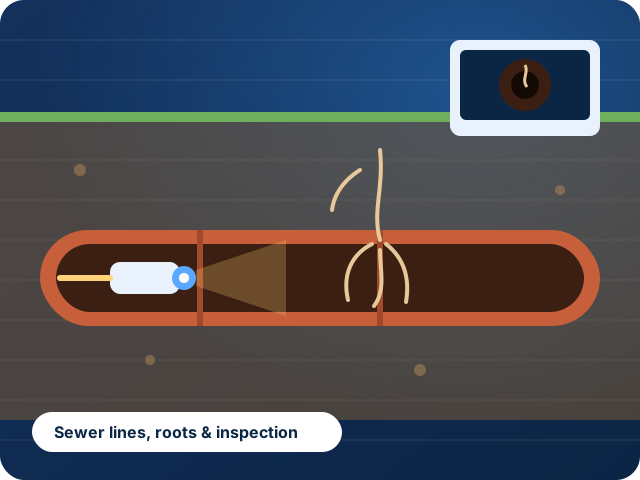
Roots rarely break into a sound pipe. They find their way in through existing openings: joints in clay pipe, cracked sections, offset connections and seams that have loosened with ground movement. Moisture escaping from those openings draws roots toward the line. Inside, a hair-thin root can branch into a mat that fills the pipe.
Clay pipe is especially prone to this because it was laid in short sections with many joints. Cast iron, Orangeburg fiber pipe and some gasketed plastic joints can also let roots in at fittings or where they have cracked or deformed.
Why roots grow back
Cutting removes the root mass inside the pipe, but the opening and the root system outside it remain. New growth usually finds the same gap. How fast it returns depends on the tree, the season and the size of the opening, which is why many owners settle into a regular cleaning cycle.
How we remove roots from a sewer line
Mechanical root cutting
A sewer cable fitted with a root-cutting head is run through the line to cut through and break up root masses. This is often the fastest way to restore flow in a stopped line. Our cable and auger page explains how these machines work.
Hydro jetting
Where the pipe is in suitable condition, hydro jetting can cut fine roots and flush fragments out of the line more thoroughly than a cable alone.
Camera inspection
After clearing, a camera inspection shows how many entry points there are, how far along the line they sit, and whether the pipe around them is cracked or separated.
Keeping roots under control
Because the openings are still there after cutting, the realistic options are:
- Scheduled maintenance cleaning to cut roots before they cause a backup. Our preventive drain maintenance page covers how to set an interval that fits your line.
- Fixing the entry points. Having the damaged sections repaired, replaced or lined by a qualified contractor addresses the cause rather than the symptom. We can explain what the footage suggests.
- Planning landscaping so new trees and large shrubs are not planted over or beside the sewer line.
We do not recommend removing healthy trees as a first step.
Tree Root Removal in Long Beach, step by step
- 1
Confirm roots are the cause
We ask about past cleanings and symptoms, since a regular backup cycle and roots on earlier cables are strong clues.
- 2
Cut and clear
We cut root masses with a cable and root head, or jet the line when the pipe condition allows.
- 3
Locate entry points
A camera run shows where roots are entering and the condition of the pipe at each point.
- 4
Plan next steps
We explain whether periodic cleaning or a repair is the better fit and roughly where the problem areas are.
Parkway trees and Long Beach sewer laterals
Many Long Beach streets are lined with parkway trees, the trees in the strip between the sidewalk and the curb. The sewer lateral usually passes right through that strip on its way to the city main, so parkway tree roots are a frequent source of intrusion near the street end of the line.
Parkway trees are typically managed by the city, so check with the City of Long Beach before cutting major roots or removing a parkway tree. Where the roots come from does not change who maintains the pipe: the lateral generally remains the owner's responsibility, as explained on our main sewer line page.