Signs the main sewer line is the problem
- More than one fixture is slow or backing up at the same time
- Water comes up in the tub or shower when you flush a toilet
- Gurgling from drains or toilets when other fixtures are in use
- Sewage or dirty water at a floor drain, the lowest fixture or the cleanout
- A sewer smell inside the house or near the cleanout in the yard
- Backups that return a few weeks or months after the last clearing
What the main sewer line does and why it clogs
Every branch drain in your home ties into a larger building drain that leaves the house and becomes the sewer lateral. That lateral runs under the yard, and often under a driveway or sidewalk, until it connects to the public sewer main. Because everything passes through it, a partial blockage there affects the whole house.
Common causes
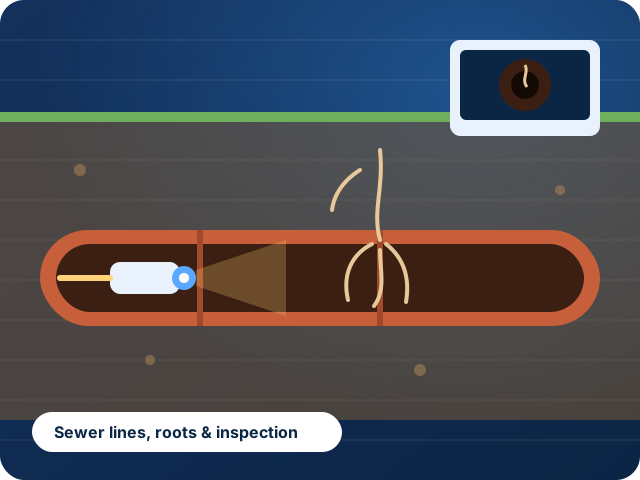
- Tree roots growing in through joints and cracks. See sewer root removal for how they get in.
- Grease and food waste that cools and hardens further down the line.
- Wipes, paper towels and hygiene products that do not break down like toilet paper.
- Sagging sections (bellies) where water and solids settle instead of flowing.
- Scale and corrosion inside older cast iron, which narrows the pipe and catches debris.
Roots, grease and a damaged section each need a different response, so identifying the cause is part of the job.
How we clean a main sewer line
Most main line work starts at a cleanout, the capped access fitting usually found near the foundation or in the front yard. If there is no accessible cleanout, we may work through a toilet flange or a roof vent, and we explain the tradeoffs first.
Open the blockage
A sewer cable is the usual first step for a line that is completely stopped. Our drain snaking page explains how cable sizes and heads are chosen.
Clean the full pipe
When the line is coated with grease, packed with sludge or full of fine roots, hydro jetting scours the pipe walls and carries the debris on toward the city main, provided the pipe is sound enough for it.
Check the result
Once the line is open, a camera run shows whether it is truly clean and whether cracks, offsets or sags are likely to cause the next backup.
What to do while you wait for service
A blocked main line has nowhere to send water, so every gallon you use rises at the lowest opening in the house, usually a shower, tub or floor drain. That is why a single flush can suddenly flood a bathroom on the other side of the home.
- Stop running water: no showers, laundry, dishwasher or flushing until the line is cleared.
- Keep children and pets away from any sewage, and wear gloves if you need to move items.
- Skip store-bought drain chemicals; they will not reach a main line clog.
- Clear a path to your cleanout if you know where it is, but do not open it if the line is full, since sewage can spill out under pressure.
When cleaning is not enough
Cleaning restores flow, but it cannot fix a pipe that is broken, crushed or badly sagged. If the camera shows structural damage, we show you the footage, note where the problem sits and talk through options such as repair by a qualified contractor or more frequent maintenance. If roots keep returning, scheduled maintenance can keep them cut back between repairs.
Main Sewer Line Cleaning in Long Beach, step by step
- 1
Confirm it is the main line
We ask which fixtures are affected and when, then check the cleanout to separate a main line clog from a branch drain problem.
- 2
Open the line
We clear the blockage with a cable or water jetting depending on what is in the pipe and its condition.
- 3
Check with a camera
Where practical, we run a camera through the line to confirm it is clean and to look for roots, sags or damage.
- 4
Explain and recommend
You get a plain-language summary of what caused the backup and what, if anything, should be done next.
Main sewer lines in Bixby Knolls, North Long Beach and beyond
Bixby Knolls and North Long Beach have many established homes on deep lots, where the sewer lateral can run a long way from the house to the street under lawns, driveways and mature trees. Long runs give roots, sags and buildup more places to cause trouble, and an older lateral may be clay or cast iron.
In Long Beach, the private sewer lateral between the house and the city main is generally the property owner's responsibility, while Long Beach Utilities operates the public sewer system. If a backup seems to be coming from the street side, Long Beach Utilities can confirm where your responsibility ends for your address.